Algerian Radio


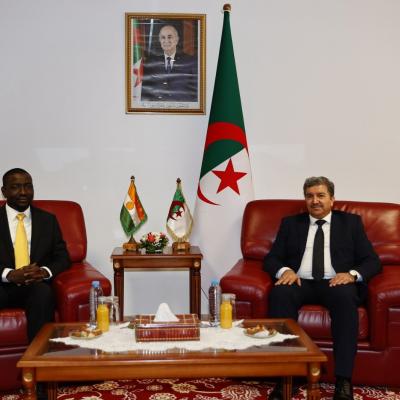
On Tuesday in Tipaza, Tunisian Health Minister, Mustapha Ferjani, reviewed Algeria’s capabilities in cardiology and cardiovascular medicine and diseases, as well as the quality of patient care within the public health sector.
Accompanied by his Algerian counterpart, Mr. Mohamed Seddik Ait Messaoudene, Algeria's guest was provided with comprehensive briefings on Algeria’s expertise in cardiology and cardiovascular medicine during a visit to the specialized department at the Tagzait Abdelkader Public Hospital in Tipaza.
Mr. Ait Messaoudene stated that Algeria "is moving toward implementing ambitious programs within its health policy, such as the creation of specialized national and regional health hubs." He cited the example of the University Hospital Department of Cardiology and Cardiovascular Medicine in Tipaza, which is equipped with a cardiac catheterization unit.
He added that Algeria "is working diligently to implement the directives of the President of the Republic to continuously develop the health map and achieve balance in patient care across various regions of the country." He noted that a cardiac catheterization unit was put into service last week at the Cardiology Department of Laghouat Hospital, and announced that a university hospital will be inaugurated in Boumerdes in two weeks, which will also feature a catheterization unit within its cardiology department.
As a reminder, the Minister of Health, accompanied by Professor, Aoudia Yazid, Head of the Cardiology Department at Tipaza Hospital, oversaw the launch of a pioneering technique at the end of last October. This medical milestone, the first of its kind nationally, involves treating cardiac arrhythmias using Pulse Field Ablation (PFA). This advanced technology is being utilized for the first time in Algerian hospitals to treat heart rhythm disorders.
Mr. Ait Messaoudene highlighted the importance of developing Algeria’s health map to encompass—beyond patient care—modernization, digitization, training, and continuous education, as well as organ transplantation, including heart transplants. He emphasized a "strong will" to advance Algerian-Tunisian cooperation in the health sector.
For his part, during his visit to the Cardiology and Cardiovascular Department, the Tunisian Minister lauded the quality of patient care and the "state-of-the-art" equipment available at the facility.
He stated that the future of health in Algeria and Tunisia "is a shared one, requiring the strengthening of cooperation to serve the health sectors of both countries and ensure the health security of the two brotherly peoples."
The occasion also provided an opportunity to visit the Royal Mausoleum of Mauretania, where the Tunisian Minister of Health was given a comprehensive briefing on the history of this monument, which is designated as a protected World Heritage site.
It is worth noting that the visit of the Tunisian Minister of Health to Algeria—leading a high-level delegation from February 1 to 3—falls within the framework of strengthening Algerian-Tunisian cooperation and partnership in the fields of health and pharmaceuticals, aiming to serve mutual interests and enhance regional health integration.