Algerian Radio




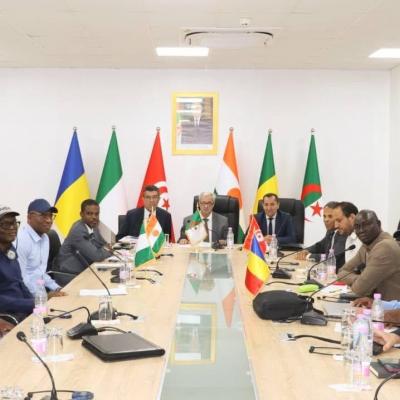
ADDIS-ABEBA, Representing the President of the Republic, Mr. Abdelmadjid Tebboune, Prime Minister Mr. Sifi Ghrib participated this Sunday in a meeting held on the sidelines of the 39th Ordinary Session of the Assembly of Heads of State and Government of the African Union (AU) in the Ethiopian capital, Addis-Abeba.
The meeting was dedicated to examining the implications of classifying colonialism as a crime against humanity and characterizing certain acts committed during the eras of slavery, forced displacement, and colonialism as acts of genocide against the peoples of Africa, based on a study prepared by the African Union Commission on International Law (AUCIL).
On this occasion, the President of the Republic addressed a speech to the participants, read by the Prime Minister. At the outset, he congratulated the AUCIL on the solid and in-depth study it had produced, considering it a qualitative and highly significant addition to the path of collective African legal thought.
President Tebboune explained that this study highlights the legal consequences of characterizing colonialism as a crime against humanity and of qualifying certain practices associated with the era of slavery, forced displacement, and colonialism as acts amounting to the crime of genocide against African peoples.
The President praised this "distinguished scientific and legal effort," affirming Algeria's "full and constant" support for all initiatives undertaken by the AU Commission and its competent legal bodies. These initiatives aim to "establish a clear and explicit legal approach that includes colonialism among the most serious international crimes, thereby enhancing the principles of accountability, enshrining non-impunity, and contributing to the establishment of equitable historical justice."
The President called for "enshrining an explicit, unequivocal international recognition—by UN organizations and colonial powers—of the criminal nature of practices that included slavery, forced displacement, ethnic cleansing, torture, displacement, and systematic persecution; practices that were unique in their scope and brutality in modern human history."
Furthermore, the President expressed Algeria's full readiness to place the documents, material evidence, and reliable historical testimonies in its possession at the disposal of competent African legal bodies. This commitment stems from its bitter national experience spanning over 132 years of extremely harsh settler colonialism. He highlighted the "scale of atrocities and grave violations committed to suppress the resistance of the Algerian people, including widespread repression and the use of means and methods prohibited under international law."
In this context, he pointed to Algeria's initiative, in cooperation with the AU Commission, to organize a high-level international conference on November 30 and December 1, 2025, under the theme: "Colonial Crimes in Africa: Towards Establishing Historical Truth and Criminalizing Colonialism." This conference culminated in the adoption of the "Algiers Appeal," which included a set of recommendations, most notably the call for official recognition of colonial crimes, working to explicitly include the criminalization of colonialism within the rules of international law, enhancing the documentation of colonial crimes, and preserving African historical memory as an integral part of historical justice.
President Tebboune also expressed Algeria's satisfaction with the adoption of its proposal to designate an official African Day to commemorate the martyrs of Africa, coinciding with November 30 of each year, "contributing to consolidating historical awareness among rising generations and preserving the memory of the sacrifices made by the peoples of the continent."
The President touched upon the step taken by Algeria at the national level, describing it as a "significant sovereign step." On December 24, 2025, the Algerian Parliament unanimously voted on a law criminalizing the colonialism to which Algeria was subjected. This law aims to establish legal responsibilities, preserve national memory, and entrench the principle of the non-applicability of statutory limitations to serious crimes as a fundamental pillar for any serious approach to reconciliation with history.
The law classifies practices such as extrajudicial executions, torture, rape, nuclear tests on civilians, and the systematic looting of wealth as crimes not subject to the statute of limitations, based on principles of international law and the rights of peoples to truth and justice.
President Tebboune stressed that "the great sacrifices made by millions of Africans for the sake of freedom, dignity, and justice cannot be forgotten or reduced to truncated narratives." He affirmed that recognizing historical truth "is not a selective invocation of the past, but a moral and legal duty and an essential entry point for building balanced international relations based on mutual respect, equity, and the preservation of human dignity."
In concluding his speech, the President affirmed that Algeria, placing this path at the center of its priorities, believes that establishing historical truth and justice constitutes a solid foundation for more balanced future partnerships and for a world governed by law rather than the logic of force.