Algerian Radio





The "Boualem Bessaih" Algiers Opera hosted a spectacular musical gala on Saturday evening to honor the late Egyptian composer Mohamed Fawzi (1918–1966), the musical genius behind the Algerian national anthem, "Kassaman." The event was held in the presence of the Minister of Culture and Arts, Mrs. Malika Bendouda.
Sponsored by the Ministry of Culture and Arts in collaboration with the Embassy of the Arab Republic of Egypt in Algeria, this commemorative concert was organized as part of the national celebrations marking the 64th anniversary of Independence and Youth Day.
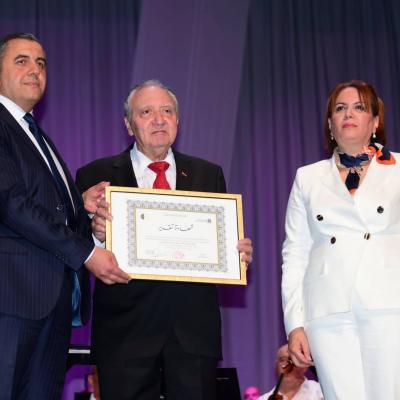
The ceremony was attended by the Egyptian Ambassador to Algeria, Mr. Abdellatif El Laih, alongside the families of the late composer Mohamed Fawzi and the eminent poet Moufdi Zakaria, who penned the lyrics of "Kassaman." Both families were officially honored by the Minister of Culture and Arts during the event, which also saw the attendance of the Director of the Algiers Opera, Mr. Mourad Senouci, and several high-ranking state officials.
In her opening remarks, Mrs. Malika Bendouda emphasized that this tribute serves as a "renewal of the pledge to the creators whose names are forever intertwined with Algeria's struggle for liberation." She stressed that "Algeria never forgets those who offered it a moment of beauty or effort."
The Minister praised Mohamed Fawzi's "rare genius" in the music world, highlighting his artistic versatility in composing both psychologically profound melodies for children and captivating pieces for adults.
Speaking on Fawzi's composition of the national anthem, the Minister underscored his sincere drive to compose and swiftly present the melody as his personal contribution to the Algerian Revolution. She equally lauded Moufdi Zakaria’s lyrical brilliance, noting that "the intersection of Mohamed Fawzi's creativity and Moufdi Zakaria's genius produced an anthem that echoes across horizons, infused with the rhythm of liberation and the profound spirit embedded in Zakaria's words."
Furthermore, Mrs. Bendouda reaffirmed Algeria's steadfast policy of immortalizing the memory of its international friends who stood by its cause, describing figures like Mohamed Fawzi as "symbols of the living human conscience."
In his statement, the Egyptian Ambassador highlighted that the event "glorifies the sacrifices of the martyrs and celebrates a shared musical heritage." He added that this tribute underscores the deep historical and militant ties between the Algerian and Egyptian peoples, showcasing the arts as a powerful tool to strengthen bilateral friendship.
For his part, the composer's son, Mr. Mounir Fawzi, expressed his father's immense pride in crafting the melodies of the Algerian national anthem, calling it "a symbolic gift in deep appreciation of the Algerian people's struggle."
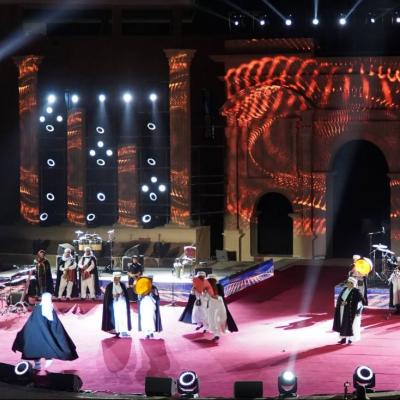
Featuring the Algiers Opera Orchestra conducted by Maestro Lotfi Saïdi, and its choir led by Zouhir Mazari, the concert opened with the resounding notes of "Kassaman." Following this, Egyptian singer Walid Haider and Algerian vocalist Nada Rayhan performed a selection of songs for an appreciative audience. Highlights included "Dari El Ouyoun Dariha," one of Fawzi’s masterpieces first performed in the 1953 Egyptian film Ibn Lil Igar.
Another deeply emotional performance was "Million Chahid" (A Million Martyrs), a song closely associated with Algeria's glorious revolution, composed and first performed by Fawzi in 1962, with lyrics by his compatriot, poet Abdelfattah Moustafa.
The evening also featured a repertoire of revolutionary anthems, including "Ya Chahid El Watan" by Ibrahim Touqan and Mahmoud Abou El Wafa, composed by Lamine Bechichi; "Min Djibalina," written by Mohamed Laïd Al-Khalifa and composed by Mohamed El Hadi Cherif; as well as the iconic song "A Yemma Aâzizen Our Tsrou" by Farid Ali.
Mohamed Fawzi remains one of the greatest Egyptian and Arab artists. A gifted composer, singer, and cinematic actor, he rose to prominence in Egyptian cinema during the 1940s and 1950s. His prolific legacy includes over 400 songs, spanning cinematic classics and timeless children's melodies like "Mama Zamanha Gaya," which gained immense popularity across the Arab world.