Algerian Radio



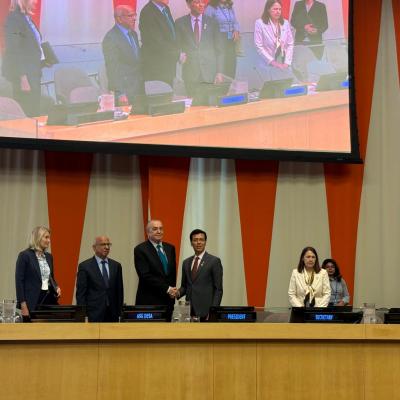
Prime Minister Sifi Ghrieb chaired a government meeting on Wednesday dedicated to the study of several files concerning health, religious affairs, telecommunications, and the fight against drugs, according to a statement from the Prime Minister’s Office, the full text of which is as follows:
"Prime Minister Sifi Ghrieb chaired today, Wednesday, April 8, 2026, a government meeting dedicated to the study of the following points:
First, the government examined a draft executive decree determining the conditions and modalities for incentivizing the disclosure of perpetrators of crimes related to drugs and psychotropic substances, their arrest, and the termination of such crimes.
This text falls within the framework of the implementation of the National Strategy for the Fight Against Drugs 2025–2029, which was approved by the Council of Ministers on April 20, 2025. The primary objective of this draft text is to strengthen deterrence and prevention mechanisms against drug abuse and illegal trafficking by involving various segments of society through a comprehensive approach, offering financial and other incentives to citizens who provide information leading to the arrest of perpetrators of these crimes.
Furthermore, within the framework of implementing the recommendations of the National Agency for Health Security, the government studied a draft executive decree determining the technical characteristics and regulation of dietary supplements intended for human consumption. It is worth noting that this draft text, prepared based on the guidelines of the joint program of the Food and Agriculture Organization (FAO) of the United Nations and the World Health Organization (WHO), aims to fill the legal vacuum regarding the safety and security of dietary supplements to avoid harmful consequences for citizens' health. In this regard, this new system includes technical specifications for dietary supplements intended for human consumption and defines the list of permitted vitamins and minerals, along with their maximum dosages.
On another level, the government heard a presentation on Quranic education, which is considered an ancient civilizational heritage in our country that has contributed to strengthening the national religious reference across generations. Religious institutions and Quranic education structures play a pivotal role in teaching the Book of Allah and its sciences, with over 1,250,000 students currently enrolled, supervised by approximately 40,000 instructors. Given the expansion of Quranic education activities and to keep pace with digital transformation, it has become necessary to organize and regulate this activity, notably by subjecting it to a book of specifications (Cahier des Charges) and providing support to those in charge. This aims to protect the national religious reference, enhance social cohesion, instill values of moderation, and connect younger generations with their authentic Algerian heritage.
Finally, the government heard a presentation on the process of decommissioning 2G and 3G wireless communication networks in Algeria, and the regulation and securing of mobile phone acquisitions for the national market. Since the emergence and spread of 4G and 5G networks in the national market, decommissioning 2G and 3G technologies has become an absolute necessity justified by technical and economic reasons. This allows, in particular, for the release of frequency spectrum resources and the development of more advanced 4G and 5G networks on one hand, and the reduction of maintenance costs for 2G and 3G equipment and network supports on the other. To this end, an action plan was proposed for the gradual implementation of the transition to new networks and the full shutdown of 2G and 3G networks by 2029. In the same context, it has become necessary to accompany this technological development by updating existing regulations to ensure the availability of mobile phones while addressing risks associated with cybercrime and the functioning of national telecommunications networks."