Algerian Radio

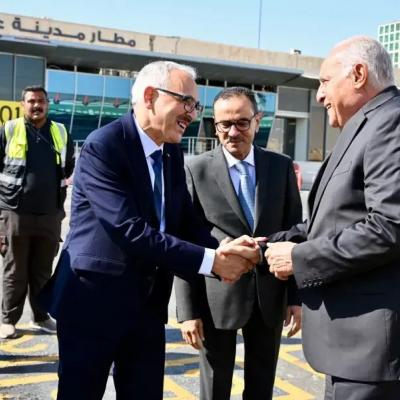
The visit of the UN Secretary-General’s Personal Envoy for Western Sahara, Staffan de Mistura, to Algeria has brought the Sahrawi issue back to the forefront, just months before the United Nations Security Council is set to examine the matter. Received by the Minister of State, Minister of Foreign Affairs, Ahmed Attaf, the UN official is continuing a series of consultations with the various parties involved as part of the preparation for his next report to the Security Council.
Speaking this Wednesday on the "Guest of the Day" program on Algerian Radio Channel 3, the President of the Algerian National Committee of Solidarity with the Sahrawi People, Said Ayachi, stated that this tour is part of the regular UN monitoring of the file. "Mr. de Mistura's presence reassures us to some extent because the UN remains seized of the matter," he declared, emphasizing that "the international organization remains the legitimate framework for addressing this question."
According to him, "Algeria’s position remains constant and is based on respect for international law and UN resolutions relating to decolonization."
"Algeria is only asking for the application of UN resolutions," he asserted, recalling that "Western Sahara has been on the list of United Nations non-self-governing territories since 1963, and the principle of self-determination for the Sahrawi people is enshrined in international texts."
Focus on the 1991 Settlement Plan Between the Polisario Front and Morocco Under UN Auspices
Mr. Ayachi also emphasized "the importance of the settlement plan concluded in 1991 between the Polisario Front and Morocco under the auspices of the UN, which provided for the organization of a self-determination referendum." In this context, he recalled the role of the United Nations Mission for the Referendum in Western Sahara (MINURSO), which was created specifically to accompany this process.
Referring to the debates preceding the adoption of Security Council Resolution 2797, he stated that several influential members of the body had reaffirmed their commitment to the principle of self-determination. "After much discussion, we reached Resolution 2797, which recognizes the self-determination of the Sahrawi people," he maintained.
The official also mentioned the work of the Fourth Committee of the United Nations General Assembly and the Special Committee on Decolonization, known as the Committee of 24. According to him, "these bodies continue to consider Western Sahara as a question of decolonization and regularly reaffirm the right of the Sahrawi people to freely decide their political future."
"The Sahrawi People Must Have Their Say"
Addressing proposals regarding an autonomy solution, Mr. Ayachi stated that no option can be imposed without prior consultation with the Sahrawis. "The Sahrawi people must have their say; you cannot impose something on them," he declared, adding that "any settlement formula should be submitted for the direct approval of the concerned populations through a consultation mechanism in accordance with international principles."
The President of the Algerian National Committee of Solidarity with the Sahrawi People also rejected the idea of a referendum extended to the entire Moroccan territory. According to him, "international law is explicit about the fact that only the people concerned by the decolonization process should be consulted." "It is the people concerned by colonization who are to be consulted, not another people," he stated.
"The Issue of Natural Resources Is a Major Aspect of the Conflict"
On the economic front, Mr. Ayachi stated that "the issue of natural resources is a major aspect of the conflict," recalling the disputes between Morocco and certain European institutions regarding the exploitation and commercialization of products from Western Sahara. According to him, "several international and European court decisions have emphasized the need to distinguish Sahrawi territory from Moroccan territory in trade agreements."
Western Sahara Issue Holds a Major Place in International Bodies
As the next UN deadlines approach, the question of Western Sahara continues to hold a major place within international bodies. Between the mediation efforts led by the UN, the demands of the Polisario Front, and the positions defended by the various parties involved, the file remains "one of the main decolonization issues still on the United Nations agenda," concluded Mr. Ayachi.