Algerian Radio










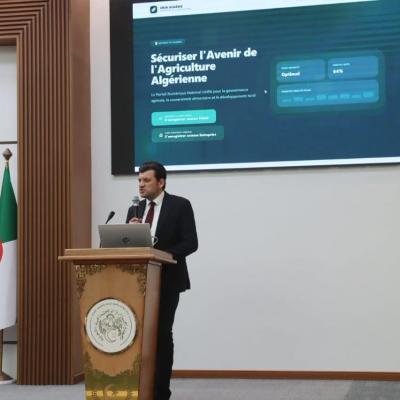
The Minister of Agriculture, Rural Development and Fisheries, Yacine Oualid, presided yesterday, Monday, in Algiers, over the launch of the National Agricultural Information System. This system aims to provide reliable and updated data on the sector to enhance governance and support decision-making at both central and local levels, as part of implementing the agricultural sector's action plan for the year 2026, particularly regarding modernization and digitization.
The system, developed by a group of young Algerian talents, was launched during a national meeting attended by sector officials at the central and local levels, directors of institutes and research centers, heads of economic groups and offices under supervision, as well as members of the National Scientific Council for Food Security, according to a ministry statement.
In his address, the Minister emphasized the significance of this information system, noting that it will allow for "the provision of accurate data on the sector and its management with greater efficiency, precision, and rigor, enabling a transition from approximate management to scientific and rational management based on reliable data."
The ministry explained that this system relies on collecting, managing, and securing data related to various functions and fields associated with agricultural activity. It also enables the administration to update this data, from its collection, processing, and analysis, all the way to its utilization in supporting decision-making.
According to the ministry, this system, which will be activated gradually across successive phases, includes a central dashboard intended for officials at the central level, as well as operational interfaces dedicated to the directorates of agricultural services and sub-divisions.
The first release of the National Agricultural Information System consists of a module specifically for monitoring the harvesting and threshing campaign. This module allows for the input and analysis of daily data regarding the progress of the campaign, addressing issues recorded on the ground—particularly concerning harvester shortages—and enabling grain producers who do not hold a farmer's card to market or deposit their crops at the bureau's warehouses, according to the ministry.
The source explained that this module also allows for "monitoring harvested areas by region and crop, tracking achieved production by entering field data, and providing accurate indicators and statistics that help make the appropriate decision at the right time."
Other modules and functions will be gradually rolled out within this system, most notably the National Agricultural Registry to build a reliable reference database for guidance and tracking. This will be joined by the Agricultural Land Registry, which allows for the characterization and monitoring of various agricultural perimeters, and the Livestock Management System to track herd numbers and vaccination programs. Additionally, the Agricultural Support Programs Monitoring System will be introduced to track allocations directed for support, measure program implementation rates, and monitor beneficiaries.
Among the modules of this system is the Agricultural Inputs System, which tracks the availability and distribution of seeds and fertilizers alongside monitoring stock levels at the national level. It also includes a unified platform for agricultural financing to track loan programs and measure financial performance indicators, a dedicated module for the agricultural insurance system to monitor coverage levels and evaluate risk protection, and a market regulation system to track wholesale and retail prices by product. Additionally, a system for monitoring water resources and climate change will oversee the filling levels of major dams.
The information system also features a module specifically for fisheries and aquaculture to monitor national marine production, the development of the fishing fleet, and the expansion of aquaculture farms. Furthermore, it incorporates a forestry resources and environment system to track the evolution of forest cover and assess forest fire risks, a monitoring system for alerts and strategic risks—particularly those related to food security, epidemics, and droughts—as well as a unified digital portal to manage various administrative procedures related to the agriculture sector, thereby ensuring the simplification of services and the digitization of its pathways, according to the ministry.