Algerian Radio










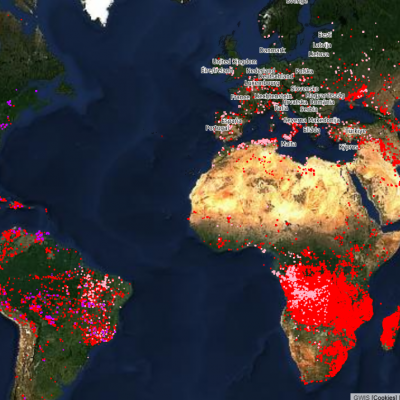
Large-scale wildfires are multiplying across Europe this summer, fueled by intense heat and severe drought, with devastating consequences for vegetation cover, public health, and the economy.
In Spain, a fire north of Madrid is ravaging tens of thousands of hectares of vegetation. "Around 32,000 hectares" have already gone up in smoke since last week about 100 kilometers north of the Spanish capital, leading to an "historic" deployment of firefighting resources.
This forest fire, located in the province of Guadalajara, is considered the largest of the year in Spain—a country on the frontline of global warming, which is causing increasingly intense and frequent heatwaves, creating conditions ripe for devastating wildfires.
Spanish Prime Minister Pedro Sanchez indicated that Spain has experienced "22 major fires" since the beginning of the year, "four times more" than during the same period last year—a sign, according to him, of the intensifying consequences of climate change.
In total, more than 120,000 hectares have already burned in Spain since January 1, according to the European Forest Fire Information System (EFFIS). This is roughly equal to "the annual average Spain suffered over the last decade," Pedro Sanchez warned.
The month of July has been marked by fires across Europe, impacting several countries. In France alone, around 15,000 hectares have gone up in smoke since the beginning of the month. Several regions have been affected by the fires, particularly Var and Corsica.
On Wednesday, a violent forest fire, which has already swept through more than 2,550 hectares in the south of France, continued its progression.
In recent weeks, French firefighters have faced daily fire outbreaks across all regions. Exacerbated by repeated heatwaves and severe drought, the 2026 fire season started earlier than usual.
Since the beginning of the year, approximately 40,000 hectares have burned, which is "much more than the total burned last year," according to French Interior Minister Laurent Nunez.
Satellite data from the European EFFIS system also shows that never, in 20 years of measurements, has so much area burned in France by mid-July.
Meanwhile, in Edinburgh, Scotland, firefighters have been battling a forest fire for several weeks that keeps flaring up on a hillside in the heart of the city.
For Pascal Mormal, a meteorologist at the Belgian Royal Meteorological Institute (RMI), there is no doubt: all these fires are linked.
"Clearly, we can see a link to global warming, insofar as we have very high temperatures coupled with a drought that has now persisted for several months," he explained.
Indeed, Europe is warming twice as fast as the global average, an alarming reality confirmed by the latest reports from the World Meteorological Organization (WMO) and Copernicus published in April 2026.
"It is becoming less and less surprising to encounter sometimes significant fires in relatively northern regions like Scotland or Scandinavia, since these areas are also now hit by increasingly high temperatures, with 30 to 35 degrees Celsius sometimes being recorded," Pascal Mormal added.
According to data revealed in the European State of the Climate 2025 report, the European continent shows an average temperature increase of 0.56°C per decade since the early 1990s, compared to just 0.27°C for the global average.
Europe, which is warming twice as fast as the global average, now faces both a climate and a public health emergency.
Nearly 10,000 excess heat-related deaths were recorded in a matter of weeks in five European countries this summer, according to data published by the European branch of the World Health Organization (WHO).
Over the past four years, more than 200,000 people have died in Europe due to heat. Over the last two decades, heat-related mortality has increased by approximately 30%.
Furthermore, due to repeated heatwaves in June, harvests are expected to yield two billion euros less for European grain farmers. France and Hungary are among the hardest-hit countries, the Financial Times reports.
"Cereal production forecasts have been revised downwards by 9 million tonnes in Europe and the UK in the four weeks following the heatwave," stated Coceral, the European association representing trade in agricultural raw materials.