Algerian Radio






Four scientific research projects are currently underway to develop food storage techniques and strengthen control tools, the Minister of Interior Trade and National Market Regulation, Amel Abdellatif, announced Monday in Algiers.
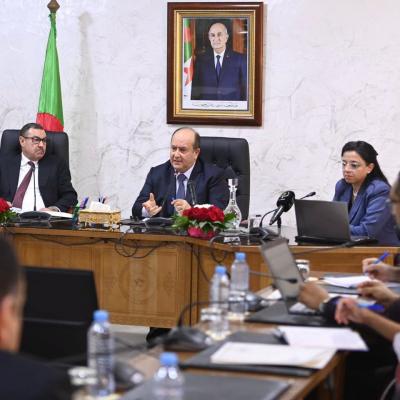
The Minister spoke during a national meeting organized by her department under the theme: "Improving the Business Climate and National Market Regulation: Between Guarantees for Businesses and Strengthening Consumer Protection." The event was attended by the Minister of Foreign Trade and Export Promotion, Kamel Rezig; the Minister of Agriculture, Rural Development, and Fisheries, Yacine Oualid; the Advisor to the President of the Republic in charge of Economic Affairs, Farid Kourtel; the Director General of Customs (DGD), Major General Abdelhafid Bakhouche; and the President of the Council for Algerian Economic Renewal (CREA), Kamel Moula.
Ms. Abdellatif specified that "in consolidation of the strategic vision of the sector, aiming to integrate scientific research into addressing technical challenges and developing innovative value-added solutions for the trade and national economy sectors, the department is currently benefiting from four national research projects." These projects focus on developing storage and packaging techniques, strengthening fraud detection tools, digitalizing information related to food products, and studying the shelf life of certain products.
These research projects are part of state efforts to ensure the quality of goods and services according to international standards, combat unfair practices, organize the market, and strengthen control and enforcement mechanisms to preserve fair competition and protect consumer rights, the Minister added.
Furthermore, Ms. Abdellatif emphasized the importance of integrating informal activities into the formal economy. She noted that her ministry is working in coordination with the Ministry of Interior, Local Authorities, and Transport to finalize a project aimed at providing young people with premises and spaces for commercial activities across various wilayas.
The Minister reminded the audience that "public authorities are working to develop an economic control system based on a balanced approach," which strengthens guarantees for companies and ensures transparency while maintaining effective regulation to protect the market and consumer rights.
The goal of this approach "is not to restrict economic activity, but to establish a clearer and fairer environment that allows companies to operate with confidence and encourages initiative and investment," she assured, noting that this cannot be achieved without an effective consumer protection system.
Revision of the E-commerce Legal Framework
During discussion sessions involving officials, experts, and researchers, participants addressed fundamental consumer rights and the importance of promoting a "reporting culture" to support control agents.
In this regard, Noureddine Haridi, Director of Quality and Consumer Protection at the Ministry of Interior Trade and National Market Regulation, revealed that the ministry is considering the launch of a digital platform dedicated to reporting non-compliant products.
Addressing E-commerce and risks associated with products of unknown origin sold online, the Sub-Director of Electronic Commerce, Ms. Wahiba Zaknoun, announced the development of a national e-commerce strategy. This is being done in coordination with various ministerial departments, public bodies, consumer protection organizations, professional associations, and economic operators.
She specified that this strategy will center on E-commerce governance through a revision of the legal framework. Since this activity is based on rapidly evolving technology, she stated it requires "an adaptation of existing legislative texts to keep pace with this dynamic," adding that the revision process has reached an advanced stage.
Discussions also focused on the ministry's role in organization and interaction with other institutions, as well as the guarantees granted to companies during control operations.
The emphasis was also placed on simplifying administrative procedures through digitalization. In this regard, a new ministry platform titled "ekhadamet," which centralizes all digital services in the sector, was announced.
The meeting concluded with a series of recommendations, including the need to develop legal frameworks for consumer protection, establish participatory governance, and develop digital platforms for receiving and processing complaints. There was also a call for an interactive digital system to ensure real-time intersectoral data exchange.
Other recommendations included strengthening coordination between border control authorities, encouraging quality management systems within companies, supporting the competitiveness of national products, and adopting a modern control system based on risk analysis. Finally, the meeting called for providing control agents with digital tools for the immediate notification of infractions and implementing a comprehensive approach to integrate the informal sector through incentives and support.